Quick answer: The loop start is the neatest beginning but only works with an even number of strands. For odd counts use a pin stitch or an in-line waste knot, and once an area is established simply run the new thread under existing stitches on the back. Each suits a different situation.
I wrote about not using knots a while back and got asked the obvious follow-up: what do you do when the loop start does not apply?
Fair question. There are four beginnings worth knowing and each has its moment.
1. The loop start
The neatest, and the one to default to.
For two strands: take one strand at double your usual length and fold it in half. Thread the two cut ends through the needle. Come up, make the first half of your stitch, then pass the needle through the loop on the back and pull gently.
It anchors itself. Nothing to work loose, nothing to bury, no bulk.
Limitation: even strand counts only. Two and four work; one and three do not. The strand guide covers when you need each.
2. The pin stitch
My preference for odd strand counts, and much less known than it should be.
Hold about 2cm of the thread tail flat against the back of the fabric, along the line you are about to stitch. Bring the needle up, then take one tiny stitch back over the tail — half a square, catching the tail underneath.
Then start stitching normally over the top. The tail is pinned down and completely hidden.
It works for single-strand backstitch too, which is where the loop start cannot help you at all.
3. The in-line waste knot
A variation on the away waste knot, and better where you can use it.
Knot the thread and go down through the front about five squares ahead of you, along the line you are about to stitch. Work toward the knot. Your stitches trap the tail on the back as you go.
When you reach the knot, snip it off. The tail is already secured — no burying required.
The away waste knot places it ten centimetres off to one side instead, which you need when the coming stitches will not run over the tail.
4. Under existing stitches
The simplest, and what you will use most once a piece is underway.
Turn the work over, slide the needle under four or five existing stitches of the same colour, then come up where you need to start. No knot, no tail, nothing.
Only works where there is already stitching to anchor into, which is why the other three exist.
Which to use when
| Situation | Use |
|---|---|
| First thread, even strands | Loop start |
| First thread, odd strands | Pin stitch |
| Single-strand backstitch | Pin stitch |
| Continuing an established area | Under existing stitches |
| Starting a new isolated block | In-line waste knot |
The one thing they have in common
None of them leaves a lump. That matters on every piece, and it matters most on anything from gifts and occasions that somebody will keep.
That is the whole point. A knot creates a bump that presses through when a piece is framed under glass, and it works loose over years because stranded cotton is slippery.
A flat back also lies properly against a mount board, which matters on anything you intend to keep.
Practising
Work each of these once on a spare margin before you need them. Five minutes.
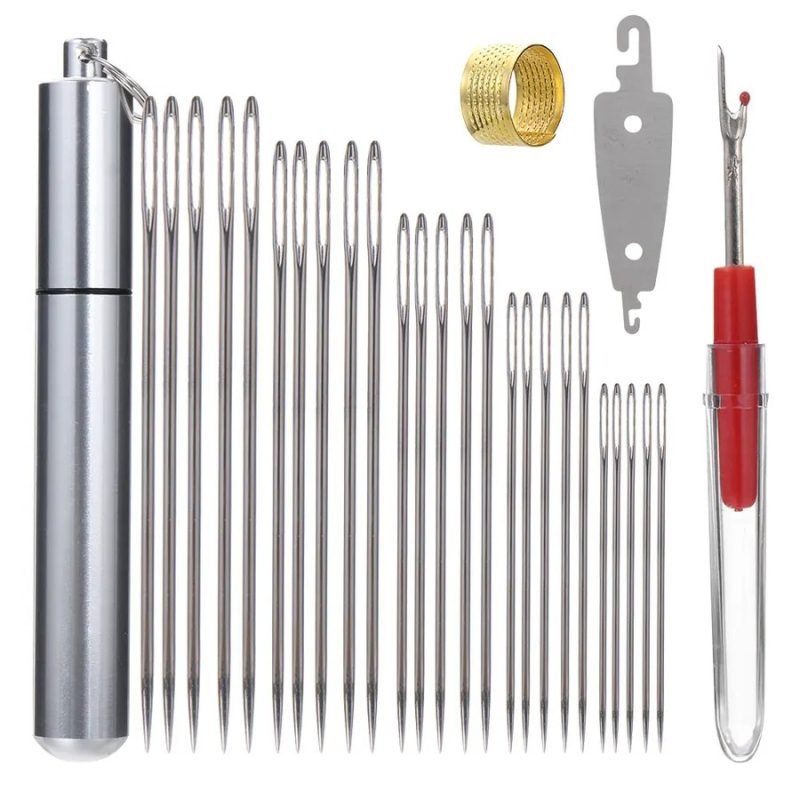
The stitch book kit is built for exactly this kind of practice, and there are more in the sampler range. You will want a needle with a decent eye — the needle set, and the needle guide covers sizing.
Then counted kits is where you will use them, and the techniques pillar guide covers what comes next.
The short version
- The loop start is the neatest beginning but needs an even number of strands.
- The pin stitch handles odd strand counts and single-strand backstitch.
- An in-line waste knot lets your stitching trap the tail as you work toward it.
- Once an area exists, simply run the thread under four or five stitches on the back.
- All four avoid a lump, which is what shows through framed work and works loose over time.
Frequently asked questions
How does the loop start work in cross stitch?
Take one strand of double your usual length, fold it in half and thread both cut ends through the needle. Make the first half of your stitch, then pass the needle through the loop on the back and pull gently. The thread anchors itself.
What do I do when I need an odd number of strands?
Use a pin stitch. Hold about two centimetres of tail flat against the back along the line you will stitch, take one tiny stitch back over it to catch it down, then stitch normally over the top. The tail is hidden completely.
What is an in-line waste knot?
A knot placed on the front about five squares ahead of you along the line you are about to stitch. You work toward it, and your stitches trap the tail on the back as you go. Snip the knot off when you reach it.
How do I start a thread in an area I have already stitched?
Turn the work over and slide the needle under four or five existing stitches of the same colour, then bring it up where you want to begin. This is the simplest method and what you will use most once a piece is underway.
Why do all these methods avoid knots?
A knot creates a bump that presses through the fabric and shows on the front once a piece is framed under glass. It also works loose over years, because stranded cotton is slippery, and it stops the back lying flat against a mount board.