Quick answer: Buy printed if counting is what worries you, and counted if you want the skill that opens up every other kit. Printed puts the design straight onto the fabric so you simply stitch what you see. Counted uses a chart, takes longer to learn, and then never limits you again.
This is the question that stops people in the shop. Two kits, similar price, similar picture, and one says counted and one says printed.
They are genuinely different crafts, and the honest answer depends on what is putting you off.
What the two words mean
Printed, also sold as stamped, has the design printed onto the fabric in coloured symbols or blocks. You stitch over what you can see. No counting, no chart-reading, no losing your place.
Counted gives you blank fabric and a paper chart. You work out where each stitch goes by counting squares from a starting point.
That is the whole difference, and everything else follows from it.
Side by side
| Printed | Counted | |
|---|---|---|
| Learning curve | Almost none | An evening or two |
| Risk of miscounting | None | Real, and manageable |
| Finished crispness | Print can peek at edges | Clean |
| Range available | Narrower | Almost everything |
| Portability | Excellent | Needs the chart to hand |
You can browse both: printed and stamped kits and counted cross stitch.
Who should buy printed
If the thing putting you off is counting, buy printed. That is not a compromise, it is the correct purchase.
Also printed if you want to stitch on a train, in a waiting room, or in front of the television without concentrating. And printed for children, hands down — our kids' kits lean that way for good reason, and the children's first stitching kit is the usual starting point.
Who should buy counted
If you think you will want to carry on past one project.
Counted is the standard. Learn it and every kit on the market opens up, including nearly all the interesting ones. It is also the version where the finished piece is crisper, because there is no print underneath to peek through at the edge of a stitch.
The learning curve is smaller than people fear — an evening or two, mostly spent getting used to keeping your place. Gridding the fabric removes most of the anxiety before it starts.
The honest concession
Printed kits get talked down, and that is snobbery.
A well-made printed kit produces a lovely finished piece and thousands of people stitch nothing else, quite happily, for years. If someone tells you it is not real cross stitch, ignore them.
What I will say is that the printed range is narrower. If you fall for the craft, you will eventually want something only available as a counted chart, and at that point you learn to count. That is the only real argument.
The middle route
Buy both, small ones, and find out. That is what I suggest most often.
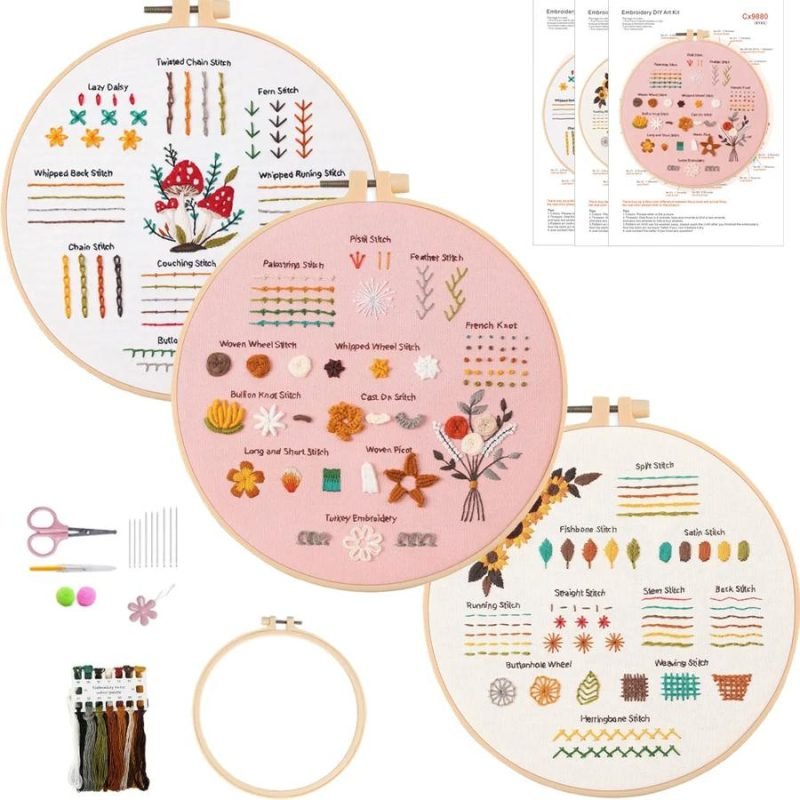
Something from easy kits or simple starters in each format costs less than one large kit and answers the question properly. The beginner starter kit with three hoops is a good counted introduction.
Read the counted versus stamped guide for the longer version, and the size guide matters more than the format either way.
One practical note
Printed kits sometimes need the print rinsing out afterwards if any shows at the edges. Check the instructions before you wash, and follow the washing method.
Counted work on plain aida has no such worry. Either way, the beginner's guide covers the first stitch, which is identical in both.
The short version
- Printed kits have the design on the fabric; counted kits use a chart and blank cloth.
- Buy printed if counting is the thing putting you off, and for children.
- Buy counted if you want to carry on past one project - it opens the whole market.
- Counted finishes crisper, because there is no print to peek out at a stitch edge.
- Buying one small kit of each costs less than one large kit and settles the question.
Frequently asked questions
What is the difference between counted and printed cross stitch?
Printed kits have the design printed directly onto the fabric, so you stitch over what you can see. Counted kits give you blank fabric and a paper chart, and you work out each stitch position by counting squares from a starting point.
Is printed cross stitch easier than counted?
Yes, meaningfully. There is no counting and no risk of losing your place, so you can stitch while distracted or travelling. The trade-off is a narrower choice of designs and the chance of printed colour peeking out at a stitch edge.
Which should a complete beginner buy?
Printed if counting is the specific thing worrying you, or if the kit is for a child. Counted if you expect to carry on past one project, because it is the standard format and learning it takes only an evening or two.
Is printed cross stitch considered real cross stitch?
Yes. It is a legitimate format that produces lovely finished pieces, and plenty of people stitch nothing else for years. The only genuine limitation is range: many designs are only published as counted charts.
Do I need to wash a printed cross stitch differently?
Check the kit instructions first. Some printed fabrics use inks intended to rinse out in cool water if any print shows at the edges of your stitching. Never press a piece before that rinse, because heat can set some inks permanently.